
Almost every owner who sells a business is doing it for the first time. The buyer across the table has often done it before. That asymmetry — not price, not negotiation skill — is the single biggest disadvantage a seller carries, and the only reliable cure is knowing what is coming.
So here is the whole thing, start to finish.
Stage 0 — The question you can ask for free
It starts with a number. Not a precise one, and not one anybody is held to — just an honest read on where the business sits today.
The valuation tool on this site asks nine questions and returns two things: an indicative range, and a scorecard across the eight factors buyers actually price. It takes a few minutes and costs nothing.
The range matters less than people expect. The scorecard is the useful half, because it tells you which of these is dragging your number down:
- How much of the business depends on you personally
- Whether one customer represents an uncomfortable share of revenue
- How much revenue is contracted or genuinely repeating
- Whether there is management below you
- Whether the way you work is written down anywhere
- How quickly your earnings can be substantiated from your books
- Which way revenue has moved over three years
- How long the business has been doing what it does
An indicative range is an estimate, not an appraisal. It is a starting point for a conversation, and it is deliberately free because that conversation is the point.
Stage 1 — The first conversation (a week or two)
Confidential, no cost, no obligation. What the business does, what you want next, and whether now is genuinely the right time. A good advisor will tell you when it is not — plenty of the best outcomes start with "wait two years and do these three things first."
You will not be asked to sign a listing agreement in this meeting. If you are, that tells you something.
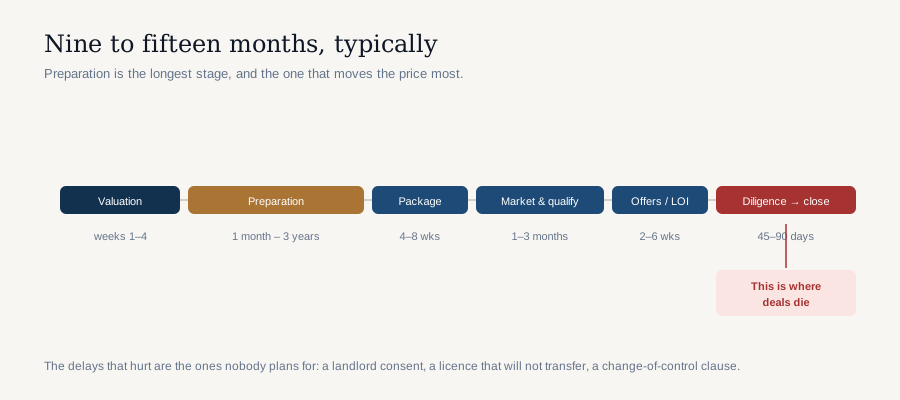
Stage 2 — Preparation (one month to three years)
The most variable stage and the one that moves the price most. This is where the scorecard turns into work: delegating the relationships that only you hold, deliberately diluting a dominant customer, promoting someone into a genuine second-in-command, writing down the processes that live in people's heads, cleaning up the books so a buyer's accountant can verify a year in days rather than weeks.
Two clean years of improved performance are worth more than an excellent explanation of last quarter. That is why this stage cannot be rushed and why starting three to five years out is not advisor's talk — it is arithmetic.
Stage 3 — Valuation, properly this time (two to four weeks)
Now with real statements, real add-backs and real comparables. Your earnings get normalised: owner compensation, personal expenses, one-off items and non-recurring costs adjusted to show what the business produces for a new owner. Every add-back needs documentation, because every one of them will be challenged.
This is where an asking price gets set, and where the range from Stage 0 either holds up or moves.
Stage 4 — Packaging (four to eight weeks)
Three documents get built:
- A blind profile — industry, region, size and story, with nothing that identifies the company. This is the only thing published.
- A confidential information memorandum — the full picture, released only after an NDA.
- A financial package — three years of statements, tax returns, the add-back schedule and the answers to the forty questions every buyer asks.
Doing this properly is what lets the next stage move fast, and speed protects confidentiality.
Stage 5 — Confidential marketing (one to three months)
The blind profile goes out. Buyers who are interested sign a confidentiality agreement and are qualified — financial capacity, financing, relevant experience, and whether they can realistically close — before anything specific is released.
On an attractive business this stage is busy. Dozens of NDAs is normal. Most of those people will never make an offer, and a good chunk are not serious buyers at all. Qualification is what keeps your time and your confidentiality intact.
Your employees, customers and competitors do not find out. That is not a nice-to-have — a leak can damage the business you are trying to sell, in the window where you can least afford it.
Stage 6 — Offers and the letter of intent (two to six weeks)
Offers get compared on structure, not just the headline number. Cash at closing versus a seller note versus an earn-out. The working capital left in the business. What you are expected to do after closing, and for how long. How conditional the offer really is.
The LOI locks the major business terms and starts an exclusivity period. Everything left vague here gets renegotiated later with lawyers on the clock — so this document deserves more attention than its non-binding status suggests.
Stage 7 — Due diligence (45 to 90 days)
This is where deals die. The buyer verifies everything asserted so far — financial, legal, operational, employment, environmental — and their lender runs a parallel process.
The rule that matters: a problem disclosed early is a negotiation. The identical problem discovered late is a trust issue, and trust issues kill transactions that money could have solved. Surface the ugly things yourself, at the start.
Stage 8 — Documentation and closing (three to six weeks)
Purchase agreement, disclosure schedules, lease assignment, licence transfers, third-party consents, escrow arrangements, payoff letters, and the funds flow that says who gets paid what on the day. Attorneys drive this stage — but the terms they are documenting were decided back at the LOI.
Closing itself is usually an anticlimax: signatures, a wire, and a business that is no longer yours.
Stage 9 — Transition and post-sale transfer (30 days to a year)
The stage owners think least about and remember most.
- Introductions. Customers, suppliers, landlord, bank — in the order and manner you agreed, not improvised.
- Employees. How and when staff are told is negotiated before closing. Handled badly, the people the buyer just paid for start updating their résumés.
- Training. Whatever the agreement specifies — commonly 30 to 90 days full-time, then a consulting arrangement.
- Systems and records. Accounts, passwords, contracts, supplier terms, the informal knowledge that never made it into a document.
- The money still outstanding. Escrow releases on a schedule. A seller note is paid over years. An earn-out depends on performance you no longer control — which is why its terms matter as much as the headline price.
Where an earn-out or a seller note exists, the sale is not finished at closing. It finishes when the last payment clears, and everything in this stage affects whether it does.
How long, all in
Nine to fifteen months from decision to wire is normal, plus however long preparation takes. The delays that hurt are rarely the ones people plan for — a landlord who will not consent, a licence that does not transfer, a customer contract with a change-of-control clause nobody had read, or books that take eleven weeks to substantiate.
Every one of those is findable months in advance and cheap to fix then.
Where to start
At the top of this article. Get the number, look at the scorecard, and decide whether you like what it says. Everything after that is a decision you get to make with better information than you had this morning.